Dog Dental Care at Home: Daily Routine Made Easy
July 30, 2026 · Artelta
Dog Dental Care at Home: Daily Routine Made Easy
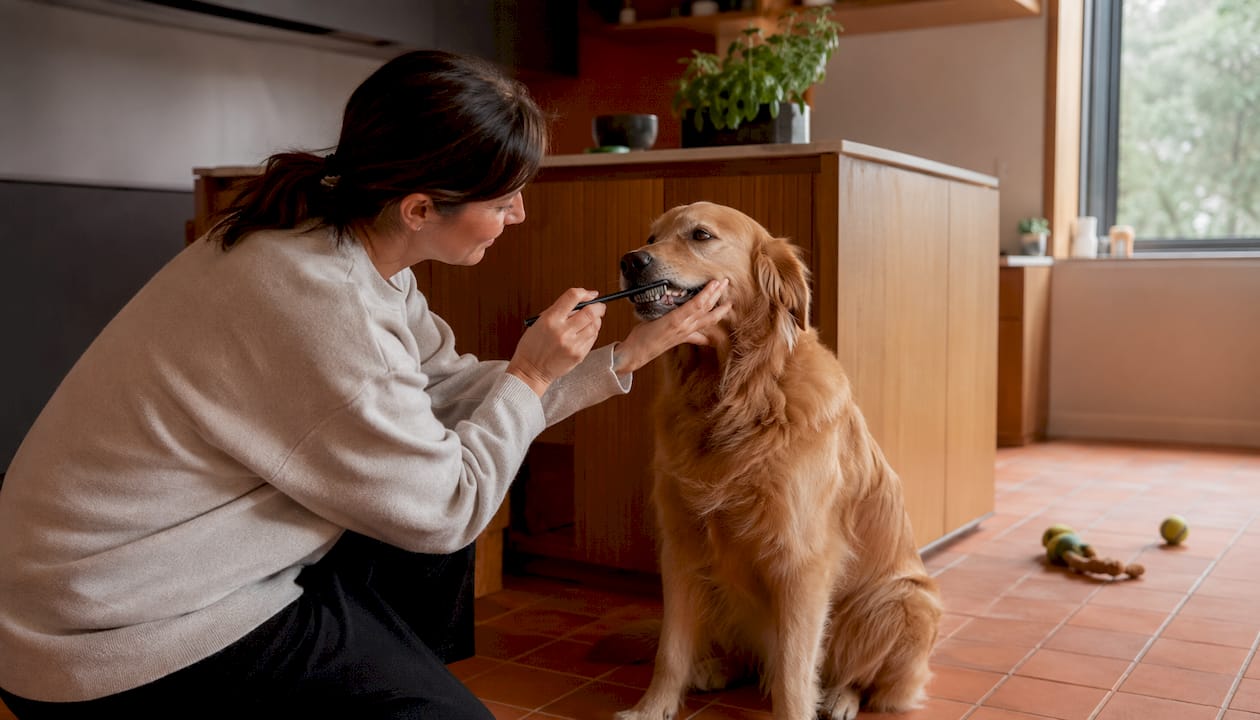
Daily toothbrushing is the single most effective thing you can do for your dog's oral health at home. Brushing is most effective when done every day, and veterinary sources consistently recommend a minimum of three times per week for meaningful plaque control. Dental chews, water additives, and prescription dental diets are valuable complements, but none of them replace the mechanical cleaning that a brush delivers at the gumline.
The bottom line: Start with a toothbrush and pet-safe toothpaste. Add VOHC-approved supplements as support. Schedule a professional cleaning if you spot red flags. Home care prevents disease; it does not treat it.
Your 24–48 hour starter checklist:
- Gently lift your dog's lips and inspect the teeth and gums for redness, tartar, or unusual odor.
- Pick up a dog-specific toothbrush (or finger brush) and a veterinary-formulated enzymatic toothpaste.
- Practice touching your dog's muzzle and lips for 30–60 seconds daily before attempting to brush.
Table of Contents
- How to brush your dog's teeth the right way
- Dental chews, water additives, and other home supplements
- What at-home care cannot fix
- Signs of dental disease and what to expect from home care
- What not to do at home
- Breed and life-stage considerations
- Building an evidence-backed at-home dental kit
- Key Takeaways
- Why the tools you choose shape the habits you keep
- Artelta's curated grooming tools support your daily care routine
- Authoritative sources and further reading
How to brush your dog's teeth the right way
Most dogs resist brushing at first. The key is a gradual desensitization sequence that builds positive associations before a toothbrush ever enters the picture.
Step-by-step brushing guide:
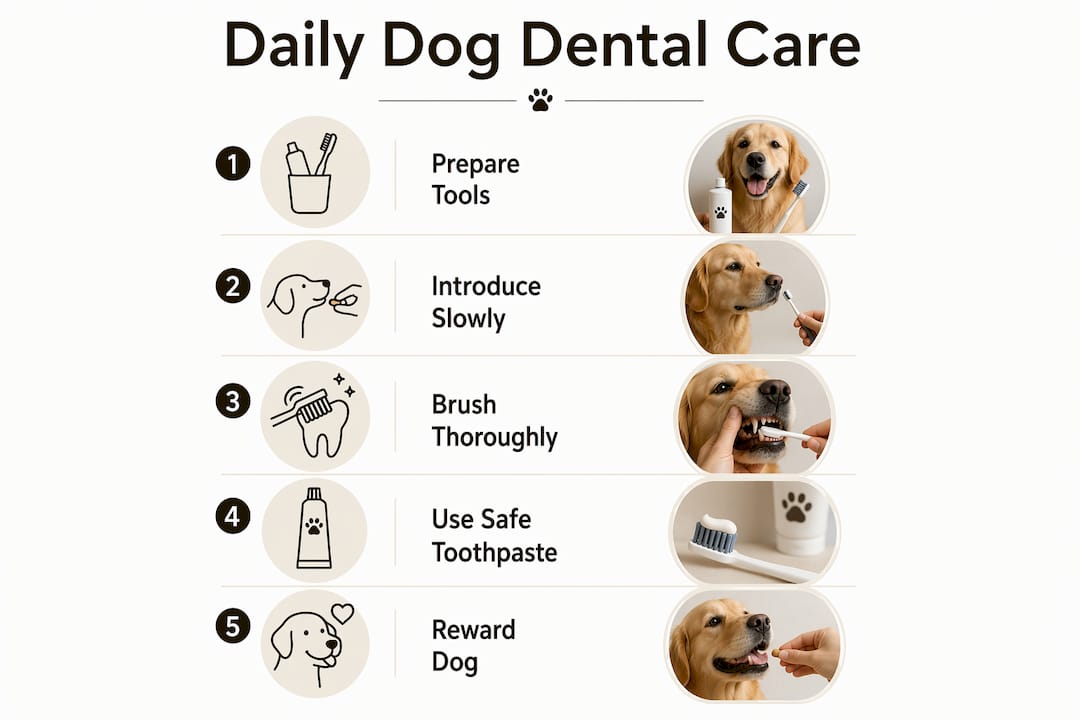
- Touch the face. Spend a few days simply touching your dog's muzzle, lips, and gums with your finger while offering praise and small treats.
- Introduce gauze or a finger brush. Wrap gauze around your finger and gently rub the outer tooth surfaces. Keep sessions under one minute.
- Add enzymatic toothpaste. Let your dog sniff and lick the toothpaste from your finger. Most dogs accept poultry or vanilla-mint flavors readily.
- Switch to a toothbrush. Choose a brush sized for your dog's mouth. Hold it at a 45° angle to the gumline, targeting the outer (cheek-facing) surfaces where plaque accumulates fastest. The tongue handles the inner surfaces on its own.
- Brush in small circles. Work from back to front, spending roughly 30 seconds per side. The full session should take about two minutes once your dog is comfortable.
- End positively. Always follow with praise, a short play session, or a VOHC-approved dental treat.
Troubleshooting a resistant dog: Shorten sessions to 10–15 seconds and work on one section of the mouth per day. Never force the brush past resistance. If your dog freezes, turns away, or shows stress signals, stop and try again the next day. Consistency over weeks matters far more than perfection in a single session.
Pro Tip: Never use human toothpaste. It often contains xylitol or fluoride, both of which are harmful when swallowed by dogs. Veterinary enzymatic toothpastes are formulated to be safe if ingested and work without rinsing.
Dental chews, water additives, and other home supplements
Brushing is the anchor habit. These products work best alongside it, not instead of it.
How each product type works:
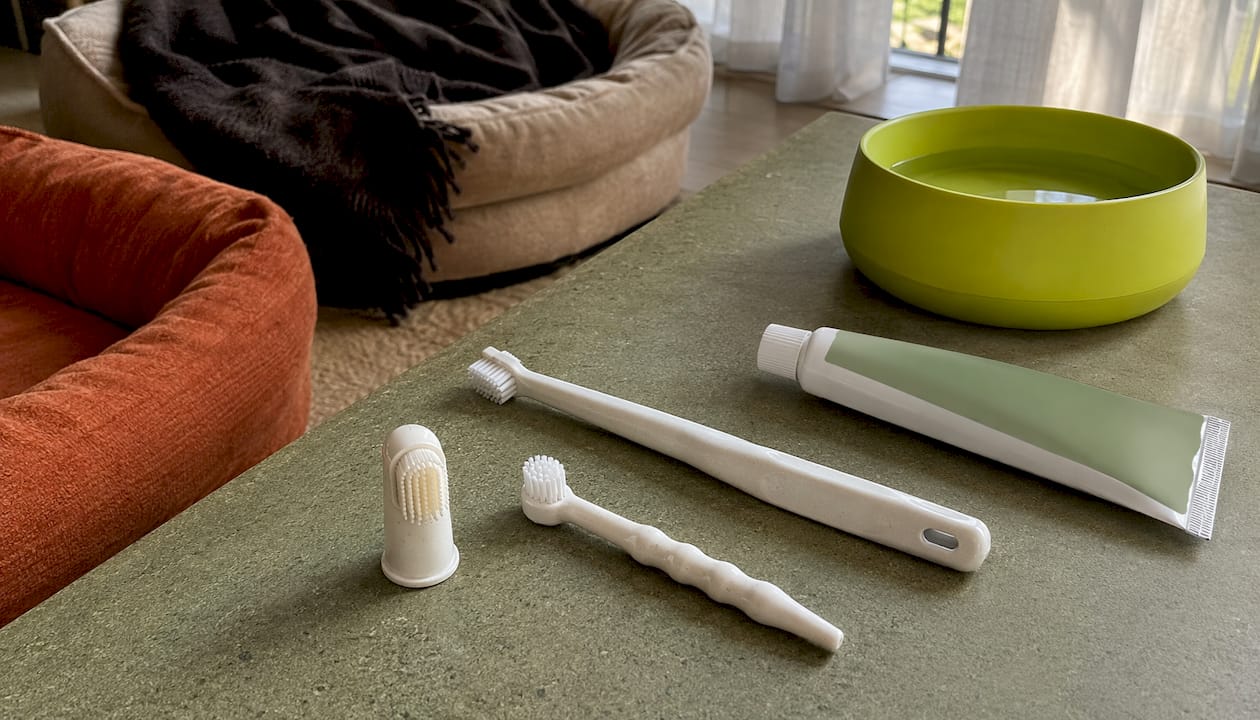
- Dental chews and treats: Mechanical abrasion from sustained chewing scrapes plaque from tooth surfaces. VOHC-approved chews have demonstrated measurable plaque or tartar reduction in controlled trials. Look for the VOHC seal on the packaging.
- Water additives and oral sprays: These deliver antimicrobial or enzymatic agents throughout the mouth with every sip. Choose a VOHC-accepted formula and follow the dilution instructions precisely.
- Dental powders: Sprinkled on food, these typically use enzymatic or probiotic action to reduce oral bacteria. Efficacy varies; prioritize products with the VOHC seal.
- Prescription dental diets: Specially designed kibble shapes create a wiping action as the tooth sinks in before the piece breaks. These are particularly useful for dogs who cannot tolerate brushing at all.
Selecting products safely:
- Always check for the VOHC seal, which confirms the product has been tested for efficacy.
- Factor in calorie content. Many dental chews are calorie-dense; adjust your dog's daily food portions accordingly.
- Avoid chews that are harder than your fingernail. If you press your thumbnail into the chew and it leaves no mark, the chew is likely too hard and risks fracturing a tooth.
- Read ingredient labels for allergens, especially if your dog has a known food sensitivity.
Statistic to know: Periodontal disease affects a large proportion of adult pets, yet fewer than 10% of owners brush their pet's teeth daily. VOHC-approved supplements help close that gap when brushing is inconsistent.
What at-home care cannot fix
Home care is preventive. Once tartar has calcified onto the tooth surface, no brush, chew, or additive removes it. At-home care cannot remove existing tartar or treat disease below the gumline, and attempting to scrape tartar at home risks injuring the gum tissue and driving bacteria deeper.
Professional cleaning is required when: tartar is visible, gums are bleeding or receding, a tooth is loose or discolored, there is a persistent foul odor, or your dog shows difficulty chewing or pawing at the mouth.
A veterinary dental cleaning under general anesthesia is the only way to address subgingival disease. Anesthesia allows the veterinarian to use ultrasonic and hand scalers both above and below the gumline, take dental radiographs to find fractured roots or bone loss invisible to the naked eye, and perform extractions or restorative work safely. Anesthesia-free cleanings are not an acceptable substitute; they clean only visible surfaces and cannot treat the disease that causes tooth loss.
| Condition | Home care sufficient? | Professional care needed? | |---|---|---| | Early plaque buildup | Yes, with daily brushing | Routine check-up | | Visible tartar | No | Yes, scaling required | | Bleeding or red gums | No | Yes, prompt evaluation | | Loose or broken tooth | No | Yes, extraction likely | | Persistent bad breath | Partial | Yes, rule out infection | | Abscess or swelling | No | Yes, urgent care |
Signs of dental disease and what to expect from home care
Catching problems early keeps treatment simpler and less costly. Inspect your dog's mouth weekly under good light, looking for:
- Yellow or brown buildup along the gumline (tartar)
- Red, swollen, or receding gums
- Persistent bad breath that does not improve with brushing
- Drooling more than usual, or dropping food while eating
- Pawing at the mouth or rubbing the face on surfaces
- Visible loose, broken, or missing teeth
The systemic stakes are real. AVMA guidance links dental infections to potential effects on the heart and kidneys, because oral bacteria can enter the bloodstream. Consistent home care protects more than your dog's smile.
What improvement looks like on a realistic timeline: Within two to four weeks of daily brushing, most owners notice fresher breath and less visible plaque on the front teeth. Significant gum health improvement takes one to three months of consistent routine. Home care will not reverse existing tartar or periodontal damage; those require professional treatment first, after which home care maintains the result.
Professional cleaning cost range: In the United States, a routine veterinary dental cleaning under anesthesia typically runs between $300 and $700, depending on the practice, geographic location, and whether extractions or radiographs are needed. This is an estimate; your veterinarian will provide an accurate quote after an oral exam.
What not to do at home
A few common mistakes carry real risk, and they are worth naming plainly.
- Never attempt home scraping or extractions. Using metal tools on teeth at home can fracture enamel, lacerate gum tissue, and push bacteria into deeper tissue. Anesthesia-free deep cleaning by untrained hands misses subgingival disease entirely and can injure your dog.
- Never use human toothpaste, baking soda, or household cleaners. Human toothpaste frequently contains xylitol, a sweetener that is acutely toxic to dogs, as well as fluoride and foaming agents that cause gastrointestinal distress when swallowed.
- Avoid overly hard chews. Bones, antlers, hooves, and hard nylon toys are common causes of slab fractures on the large back teeth. Apply the fingernail test: if the chew does not yield to your thumbnail, it is too hard.
- Do not skip the vet because home care seems to be working. Subgingival disease is invisible without radiographs. A dog can appear comfortable while significant bone loss is progressing beneath the gumline.
Rule of thumb from UC Davis Veterinary Medicine: If you would not want it hit against your own knee, it is too hard for your dog's teeth.
Breed and life-stage considerations
Not every dog carries the same dental risk, and adjusting your approach to your dog's age and anatomy pays off over time.
- Puppies: Start desensitization as early as eight weeks. Puppies lose their baby teeth between three and six months, so focus on building the habit and positive association rather than aggressive cleaning. Early exposure makes adult brushing far easier.
- Senior dogs (7+ years): Watch for appetite changes, weight loss, and increased reluctance to chew hard food. These can signal tooth pain. Schedule dental exams at least twice yearly rather than annually, and ask your veterinarian about pain management options if dental disease is present.
- Brachycephalic breeds (Bulldogs, Pugs, Shih Tzus, French Bulldogs): Compressed jaw anatomy causes tooth crowding and faster periodontal disease progression. These dogs often need professional cleanings earlier and more frequently than the average dog.
- Small breeds (Chihuahuas, Dachshunds, Yorkshire Terriers): Proportionally larger teeth in a small jaw create similar crowding issues. Daily brushing and earlier professional intervention are the standard recommendation.
Pro Tip: Match your tools to your dog's size. A finger brush works well for toy breeds and puppies; a long-handled angled brush gives better reach for large breeds. The right fit makes the routine faster and more comfortable for both of you.
Building an evidence-backed at-home dental kit
A well-chosen kit removes the friction of daily care. Here is what to assemble, and why each item earns its place.
Essential items:
- Dog toothbrush: Choose a head size appropriate for your dog's mouth. Angled handles help reach the back molars. For small dogs or puppies, a finger brush is often easier to control.
- Veterinary enzymatic toothpaste: Enzymatic formulas break down plaque chemically between brushing sessions. Choose a flavor your dog enjoys; compliance depends on it.
- Dental gauze or wipes: Useful during the desensitization phase and as a backup on days when a full brush session is not practical.
- VOHC-approved dental chews: One per day as a supplement to brushing, not a replacement. Factor calories into daily intake.
- VOHC-approved water additive: A low-effort daily supplement that requires no training. Confirm the formula is safe for your dog's size and health status.
- Small flashlight or penlight: Makes weekly oral inspections far more thorough. You cannot address what you cannot see.
| Kit item | Purpose | Selection criteria | |---|---|---| | Dog toothbrush | Mechanical plaque removal | Size-matched to dog's mouth; angled handle preferred | | Enzymatic toothpaste | Chemical plaque breakdown | Pet-specific, no xylitol or fluoride | | Dental gauze/wipes | Desensitization and backup cleaning | Soft texture, unflavored or mildly flavored | | VOHC-approved chews | Supplemental mechanical abrasion | VOHC seal; passes fingernail hardness test | | VOHC water additive | Antimicrobial daily support | VOHC seal; appropriate for dog's weight | | Penlight/flashlight | Weekly oral inspection | Compact, bright; any standard model works |
Well-designed tools with comfortable grips and appropriate brush-head sizes genuinely increase daily compliance. The ergonomics of the tool matter because a brush that feels awkward in your hand is one you will skip.
Key Takeaways
Daily toothbrushing is the cornerstone of effective dog dental care at home, supported by VOHC-approved supplements and backed by regular professional cleanings when red flags appear.
| Point | Details | |---|---| | Brush daily, minimum 3x/week | Brushing less than every other day delivers significantly less plaque control. | | VOHC seal is the product standard | Choose chews, water additives, and treats that carry the VOHC acceptance seal for verified efficacy. | | Home care cannot remove tartar | Professional cleaning under anesthesia is required once tartar has formed or disease is below the gumline. | | Know the red flags | Bleeding gums, loose teeth, persistent bad breath, and difficulty eating all warrant prompt veterinary evaluation. | | Artelta curated tools reduce friction | Ergonomically designed grooming accessories from Artelta support daily consistency and make the routine easier to maintain. |
Why the tools you choose shape the habits you keep
The conventional advice on dog dental care focuses almost entirely on technique, and technique matters. But there is an underappreciated variable: the quality and feel of the tools themselves. A toothbrush that fits awkwardly in your hand, or a kit that lives in a cluttered drawer, is a routine waiting to be skipped.
Veterinary guidance from the AVMA and AAHA is clear that daily brushing is the gold standard. What that guidance cannot account for is the behavioral reality of maintaining a daily habit. Owners who use well-designed, comfortable tools report higher compliance, and that is not a trivial detail when periodontal disease affects roughly 70% of adult pets in part because home care routines lapse.
The case for investing in better tools is not aesthetic vanity. It is behavioral design. A brush that feels good to hold, a kit stored where you can see it, and a routine that takes two minutes rather than ten are the actual levers of consistency. VOHC and veterinary recommendations remain the non-negotiable baseline. But within that baseline, the quality of your tools determines whether the routine survives contact with a busy Tuesday morning.
Gradual progress beats perfect technique abandoned after a week. Start where you are, use the best tools you can, and let consistency do the work.
Artelta's curated grooming tools support your daily care routine
Maintaining a daily dental routine is easier when your tools are designed to work with you. Artelta's curated selection of grooming and wellness accessories is built around that principle: premium materials, ergonomic design, and a finish that makes daily care feel less like a chore.
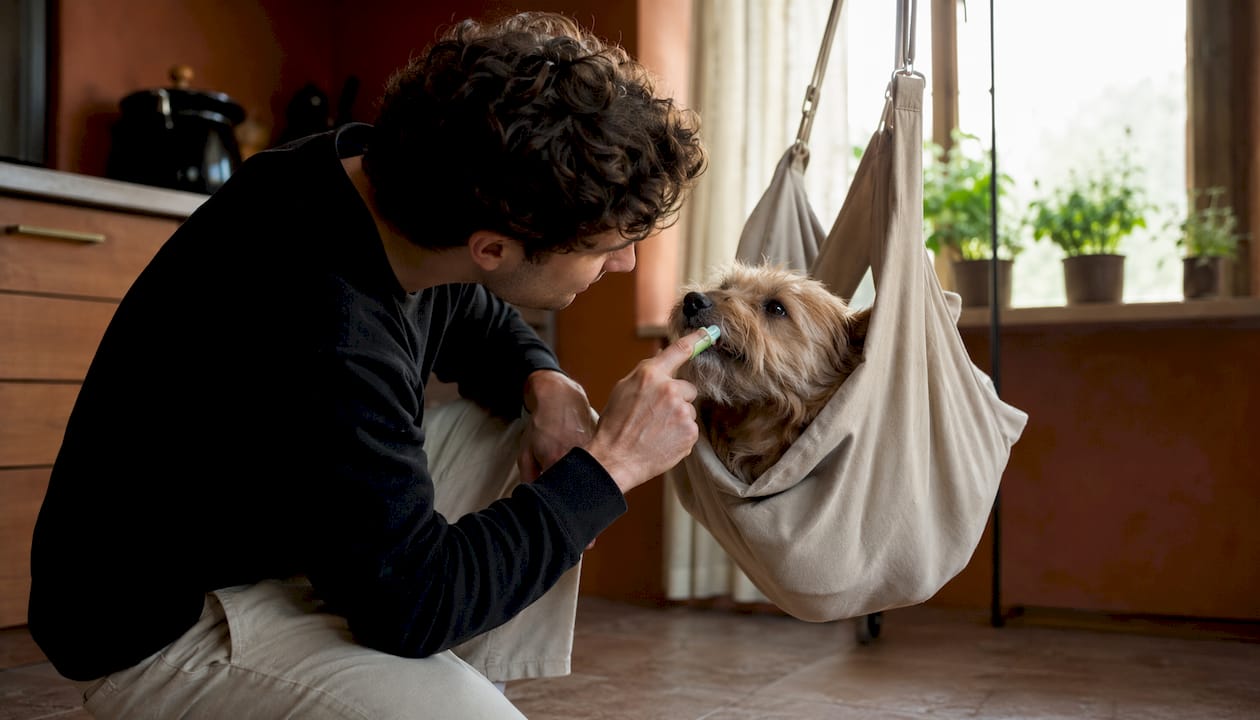
The Grooming Hammock gives anxious dogs a calm, supported position during brushing, reducing resistance and making the session safer for both of you. For owners who want a complete grooming setup, the Grooming Vacuum Pro handles loose hair and dander during the same session, keeping the routine consolidated and efficient. Every Artelta product ships with complimentary shipping and a straightforward return policy.
Browse the full grooming and wellness collection at Artelta and find the tools that make your dog's daily care routine one you will actually keep.
Authoritative sources and further reading
The following sources were used in preparing this article and are recommended for further reading.
- Cornell University College of Veterinary Medicine — Detailed guidance on dental disease, home care methods, and what professional treatment involves; one of the most thorough veterinary teaching hospital resources available.
- American Veterinary Medical Association (AVMA) — Covers the systemic health implications of dental disease and general pet dental care recommendations from the leading U.S. veterinary authority.
- Veterinary Oral Health Council (VOHC) — The official body that awards the VOHC seal; use this site to search for currently accepted products by category.
- VCA Animal Hospitals — Practical, step-by-step brushing instructions and safety guidance on toothpaste ingredients.
- AAHA (American Animal Hospital Association) — Statistics on owner compliance and periodontal disease prevalence; guidance on multi-modal home care routines.
- UC Davis Veterinary Medicine — Home care instructions including the fingernail test for chew hardness and the case against anesthesia-free cleanings.
This article is general information, not professional veterinary advice. Consult your veterinarian for guidance specific to your dog's health, breed, and dental history.