How to Groom a Dog That Hates Being Brushed
July 18, 2026 · Artelta

If you're wondering how to groom a dog that hates being brushed, the first thing worth knowing is that the problem is rarely the brush. It's the story your dog has built around it. Somewhere along the way, brushing became something to endure or escape: a tug through a matted patch, a session that went on too long, a tool that scraped instead of glided. The good news is that stories can be rewritten. It takes patience, a little structure, and a willingness to move at your dog's pace rather than your own.
This is not a quick fix. It is a quiet one. Most owners who follow the approach below see a real shift within two to three weeks. Some see it in days.
Start by understanding the refusal
Dogs don't resist brushing out of stubbornness. They resist because something about the experience feels bad or unpredictable. Before you change anything, spend one session simply observing. Bring out the brush, set it on the floor, and watch. Does your dog leave the room? Sniff it and stay? Tense up only when you pick it up?
Where the resistance begins tells you where the work begins. A dog that flees at the sight of the brush needs to relearn what the brush means before it ever touches fur. A dog that tolerates the first few strokes and then squirms is telling you something simpler: the sessions are too long, or a particular spot hurts.
Check the tool itself, too. Slicker brushes with fine wire pins can scratch skin if pressed too hard, and many dogs with thin coats or sensitive skin find them uncomfortable no matter the pressure. If your dog's aversion appeared suddenly, it's worth ruling out a physical cause, such as a skin irritation, a hidden mat pulling at the skin, or soreness in an aging joint that makes standing still uncomfortable.
Rebuild the association, one small step at a time
The method here is old, unglamorous, and reliably effective: pair the brush with things your dog loves, in doses so small that fear never gets a foothold.
For the first few days, the brush earns its keep without brushing anything. Set it down near your dog's food bowl at dinner. Hold it casually while you hand over a treat. Let it become furniture: boring, predictable, attached to good things.
Once your dog is relaxed around the sight of it, begin touching, not brushing. Rest the back of the brush against the shoulder for one second, then treat. The shoulder matters, because most dogs accept contact there far more readily than on the hindquarters, tail, or belly. Keep these sessions almost absurdly short. Thirty seconds is plenty. End while your dog is still comfortable, always. Stopping early is the entire trick. Every session that ends calmly is a deposit in the account; every session that ends in a struggle empties it.
From there, progress to a single soft stroke, then two, then a slow expansion outward from the shoulders. If your dog stiffens, lip-licks, yawns, or turns away, you've moved too fast. Go back one step and stay there a while longer. This is not a setback. It is the process working as designed.
Set the scene before you set the brush down
Environment shapes behavior more than most of us credit. A few adjustments make every session easier:
- Choose a low-energy moment. After a walk or a meal, when your dog is naturally settled, is far better than mid-zoomies.
- Same place, same time. Ritual is calming. A mat in a quiet corner, used only for grooming, becomes its own cue that nothing alarming is about to happen.
- Keep your own body loose. Dogs read tension fluently. If you approach the session braced for a fight, your dog will brace too. Slow hands, soft voice, no looming.
- Put the treats somewhere reachable but not in your brushing hand. Fumbling breaks the rhythm.
Some owners find that a licking mat smeared with a little wet food occupies the front end of the dog beautifully while the back end gets brushed. There is no shame in this. Use whatever keeps the experience pleasant.
Handle mats and problem areas separately
Nothing undoes weeks of careful work faster than yanking a brush through a mat. Tangles should never be pulled apart during a regular session; the pain confirms every suspicion your dog ever had about brushing.
Work mats with your fingers first, holding the base of the mat against the skin so the tug doesn't transfer. A detangling spray helps. For anything dense or close to the skin, clipping it out (carefully, with blunt-tipped scissors and a comb slid between mat and skin) or booking a professional groomer is kinder than a prolonged battle. One uncomfortable extraction is worth trading for a dozen calm sessions afterward.
Sensitive zones come last in your progression: tail, belly, ears, and feet, sometimes weeks after the shoulders are easy. Some dogs never fully love having these areas brushed. Aim for tolerance, not bliss.
Choose tools that keep the peace
The quieter and gentler the tool, the faster the story changes. Soft-pinned brushes and grooming gloves are good first tools for a suspicious dog, because they feel closer to petting than grooming. As trust builds, you can introduce whatever the coat actually requires.
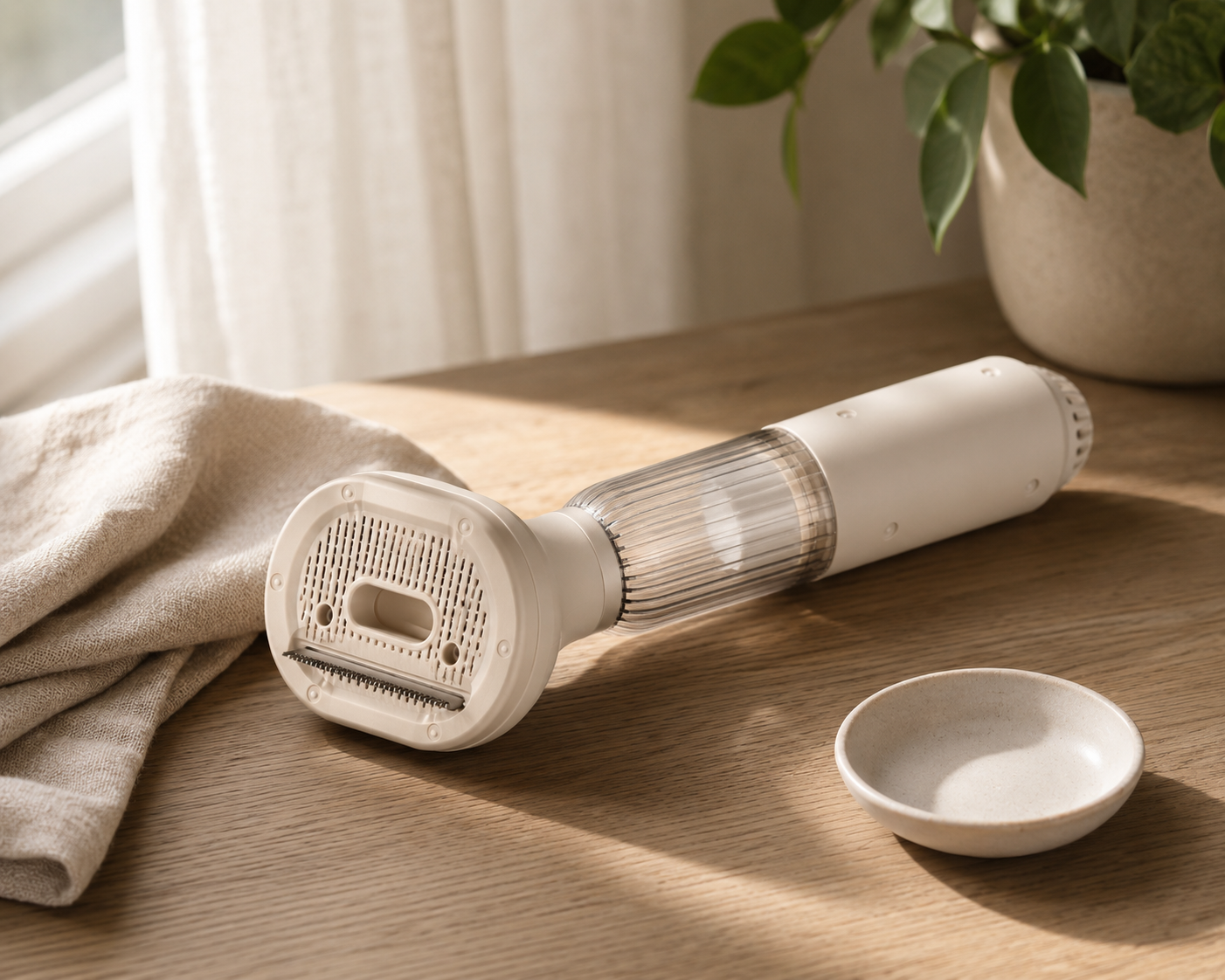
For heavy shedders, one practical note: much of the unpleasantness of a long session is the loose hair itself. It drifts, it sticks, and it prompts owners to brush harder and longer to chase it. A tool like the Compact Grooming Vacuum collects hair as you brush, which keeps sessions shorter and the pressure lighter. Lighter and shorter is precisely what a reluctant dog needs.
Whatever you use, introduce it with the same patience you gave the first brush. Set it down, let it be sniffed, and let it run briefly in the next room before it ever comes near the coat.
What progress actually looks like
Progress with a brush-averse dog is not linear, and it rarely looks dramatic. It looks like a dog that stays in the room. Then a dog that wanders over. Then, one evening, a dog that leans into the stroke, and you realize the argument is over.
Keep sessions short even after they become easy. Five minutes of calm brushing several times a week maintains most coats better than one long weekly ordeal, and it protects the trust you've built. If you hit a wall, if the fear seems severe, or if your dog has ever snapped during handling, bring in a certified force-free trainer or ask your vet for guidance. There is no prize for doing this alone.
The brush was never the point, anyway. The point is a dog that trusts your hands. Brushing is just where that trust becomes visible.