How to Tire Out a High-Energy Dog Indoors
July 30, 2026 · Artelta

Every owner of a high-energy dog eventually needs to know how to tire out a high-energy dog indoors. The reason varies: a week of freezing rain, a heatwave, an injury on crate rest, a small flat and a twelve-hour shift, a Belgian Malinois acquired in a moment of optimism. The situation is the same. There is a dog vibrating in the hallway, the outdoors is unavailable, and the sofa is starting to look negotiable.
The first thing worth saying is that the standard solution, more physical exercise, has a ceiling indoors and a catch everywhere. You cannot run a working-breed dog to exhaustion in a corridor, and even outdoors, pure cardio mostly builds a fitter dog who needs more cardio. The indoor answer is different: you tire the brain, you structure the body work you can do, and you stop being the only source of stimulation in the house.
Mental work is the multiplier
Trainers repeat it because it keeps being true: a focused thinking session drains a dog like little else. Problem-solving is expensive for a dog's brain in a way that trotting simply isn't, and many owners find fifteen minutes of it buys an afternoon of calm.
The cheapest version is training itself. Not perfect-heel drilling, but short, punchy sessions teaching something new: spin, back up, put your toys in the box, touch the target. Five minutes, three times a day. New material, not rehearsed material, is what costs effort. A dog learning "hold this" for the first time is working harder than a dog doing its hundredth sit.
Then there is nose work, the most under-used tool in the indoor arsenal. Scatter kibble in a snuffle mat or across a towel-covered floor. Hide treats in one room while the dog waits in another, then release with a "find it." Start absurdly easy so the game makes sense, then escalate to treats inside boxes, under cups, on (sturdy) shelves. Scent work taps the deepest software a dog runs, and twenty minutes of serious sniffing produces the kind of flat-on-the-side sleep that a walk twice as long often doesn't.
Structure the physical outlets you do have
Indoors, unstructured energy release tends to become zoomies at best and remodeling at worst. Structured beats wild:
- Tug, with rules. Take it, drop it, take it again. The rules are the point: a dog that switches between full arousal and full release on cue is doing impulse-control work disguised as a game, and impulse-control work is exhausting.
- Stair fetch, for dogs with sound joints. A soft toy thrown up a carpeted flight, walked down calmly. Five rounds is a workout. Skip this for puppies, seniors, and long-backed breeds.
- Flirt pole in the largest room. Two minutes of chase, then a settle. Arousal up, arousal down, repeated. The settle is half the exercise.
- Hallway recalls. Two people, opposite ends of the home, calling the dog back and forth for treats. Cardio, recall practice, and family entertainment in one.
Keep sessions short and end them deliberately, with a chew or a licking mat as the closing act. Licking and chewing are themselves settling activities, and the ritual teaches the dog that excitement is followed by rest, which is the exact skill a high-energy dog most needs indoors.
Outsource part of the job
The trap with a high-energy dog indoors is that you become the entertainment system, and the entertainment system is not allowed to be tired, on a call, or making dinner. Part of the day's stimulation should run without you.
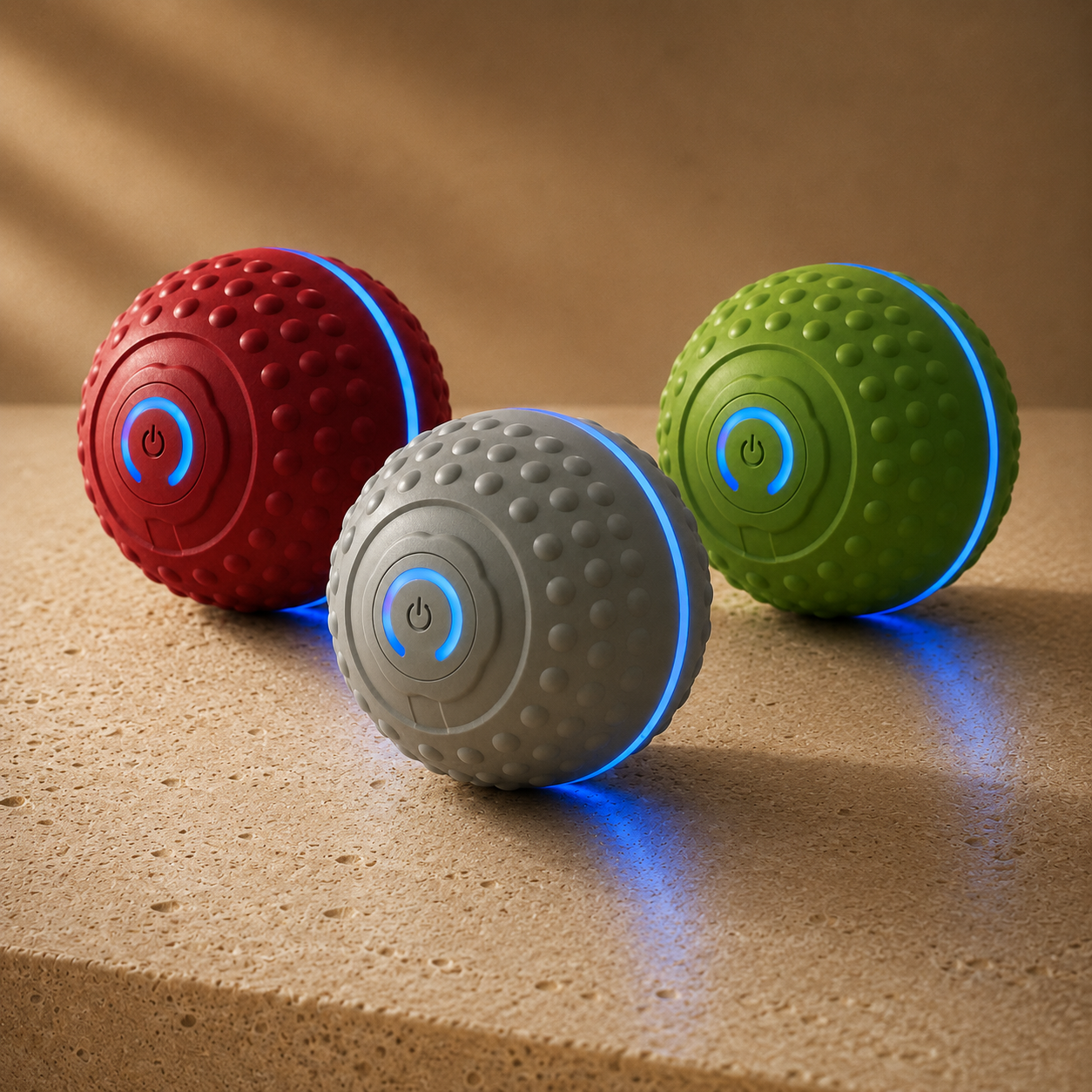
Long-lasting chews and frozen food toys handle the settling end. For the chasing end, the toy has to move on its own, because a stationary ball is a solved problem to a dog with drive. Self-rolling balls have gotten properly good at this: they scoot, bounce, and change direction like something worth hunting, wake when the dog noses them, and shut themselves off when the game winds down. The practical catch with any rechargeable toy is the duty cycle: roughly an hour of charging buys about two hours of play, and a truly relentless dog notices the gap. That is the honest case for running The Fetch as a pair, two balls in rotation, one on the charger while the other is on shift, so the game is available whenever the dog is. For a single-speed household, one is plenty; for the dog that treats "tired" as a rumor, the rotation is the fix.
Chew-resistance matters more with this crowd than any other. High-energy dogs are frequently high-power chewers, and a satisfying kill is part of their game. Whatever moving toy you choose, durable materials are the difference between a playmate and a casualty, and no powered toy should be a substitute for the unsupervised-chewing rule: if your dog dismantles things, moving playtime happens while someone is home, and the indestructible-rated chew handles the solo shift.
Build the day like a circuit
The pieces work best in sequence rather than scattered at random. A high-energy indoor day that actually lands looks like a circuit: a training burst at breakfast, nose work mid-morning, a structured game at midday, the self-propelled playmate taking the afternoon shift, and a wind-down chew in the evening. Brain, nose, body, chase, settle. If the dog is alone for the middle of it, the same logic applies with the human parts moved to the edges of the day; we've written a full home-alone plan in How to Keep Your Dog Entertained While You're at Work.
Two honest caveats close this out. First, rest is part of the program: a dog stimulated every waking hour learns to expect stimulation every waking hour, and you will have built a monster with excellent cardio. Teaching an off-switch, a settle on a mat while life happens around them, is as valuable as any game here. Second, if what looks like excess energy includes pacing that never stops, destruction focused on doors and windows, or frantic behavior that play doesn't dent, talk to your vet or a qualified trainer, because that pattern is about something other than boredom.
For the ordinary tornado, though, the formula holds. Work the brain, structure the body, outsource the chase, protect the naps. The weather can do what it likes.