Cat Grooming for Cats That Hate Brushing
July 18, 2026 · Artelta

Cat grooming for cats that hate brushing is its own discipline, and it starts with accepting a truth that dog owners never have to face: a cat cannot be talked into anything. A dog that dislikes the brush can often be coaxed, distracted, or gently outlasted. A cat that dislikes the brush will leave. Or swat. Or deploy the particular full-body stillness that every cat owner knows precedes teeth.
And yet most cats do need some grooming help. Long-haired cats need it to prevent mats, older cats because their flexibility no longer reaches the lower back, heavy shedders because loose hair otherwise becomes hairballs and upholstery. The way in is not persistence. It is making brushing feel like the cat's idea.
Why your cat says no
Cats are meticulous self-groomers, which means being groomed by someone else is not a neutral experience; it is an intervention. Several things commonly turn it into an unwelcome one.
Overstimulation is the big one. A cat's skin is dense with touch receptors, and repeated strokes in the same area build up sensation quickly. What felt pleasant at stroke five feels electric at stroke fifteen. This is why many cats accept a minute of brushing and then bite: they are not being capricious, they have simply hit a threshold.
Then there is territory. Most cats accept contact at the cheeks, chin, and the base of the ears, the places they'd rub against you anyway. The belly, hindquarters, tail, and legs are another matter entirely. A brushing routine that begins at the rear will fail on principle.
Pain hides here too. Mats pull at skin with every movement, and brushing over one hurts. Arthritic cats, far more common than diagnosed (especially past age ten), may resent handling over the hips and spine. A cat whose grooming aversion is new, or who has stopped grooming itself thoroughly, warrants a vet visit before a behavior plan. Greasy fur, dandruff, or clumping along the back in an older cat is a health signal, not a preference.
Let the cat set the terms
The core method is consent-based, which sounds precious until you watch it work. The cat controls the session; you control the setup. Given actual control, most cats become far more generous than expected.
Begin with the brush as an object of no consequence. Leave it where the cat lounges. Rub a little dry catnip on it if your cat responds to catnip. Let it be sniffed, cheek-rubbed, ignored. A cat that has claimed the brush by rubbing its face on it has, in a sense, already agreed to the project.
When you begin actual contact, follow three rules. Start where affection already lives (cheeks, chin, around the ears), using slow strokes in the direction of the fur. Keep it brief: three to five strokes, then stop and let the cat decide whether to stay. And watch the tail. A softly upright or draped tail means continue; twitching or thumping means you are two strokes past enough.
Ending before the threshold is the entire craft. The cat learns that brushing never becomes trapping, and that lesson, more than any treat, is what brings it back.
Treats still help, of course. A lick of paste-style treat during and after keeps the ledger positive. Short daily sessions beat long weekly ones by a wide margin; a minute a day is a perfectly respectable ambition.
Match the tool to the cat
Cats are opinionated about texture, and the wrong tool ends negotiations early. Fine-wired slicker brushes, the default for many owners, are often the problem: on a cat's thin skin they can scratch, especially over bony areas.
Softer entries do better. Grooming gloves feel like petting and are the easiest first step for a suspicious cat. Rubber curry brushes with broad, flexible nubs suit short-haired cats and remove a surprising amount of loose hair. For long-haired cats, a wide-toothed comb worked in sections is gentler than dragging a brush the length of the body, and it finds forming tangles before they become mats. Whatever the tool, pressure should be light enough that you could use it on your own eyebrow without wincing.
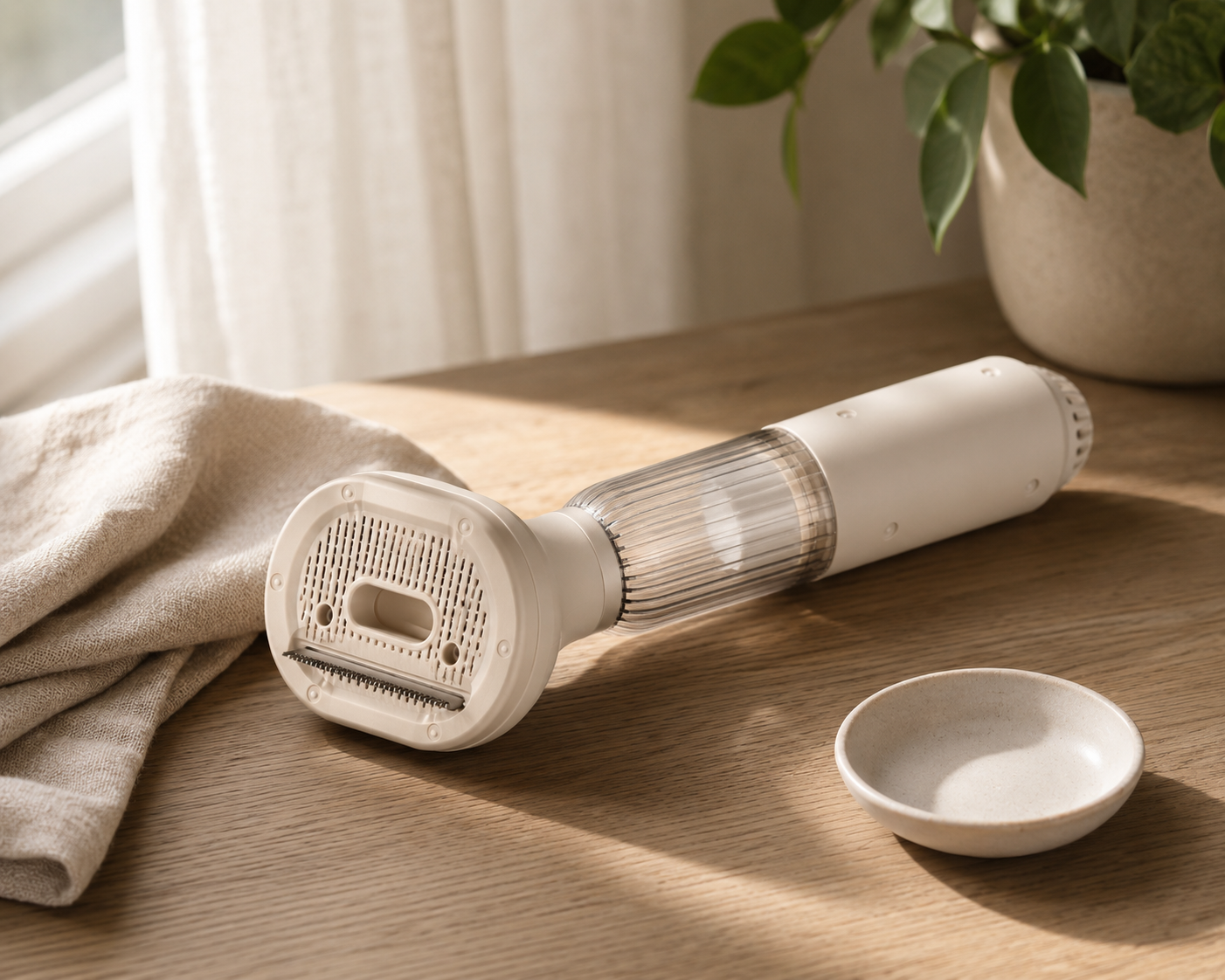
For households where the real grievance is hair (on the sofa, in the corners, coughed up on the stairs), hair-collecting tools like the Compact Grooming Vacuum can shorten sessions by catching loose fur as it lifts, which suits cats precisely because it leaves less to chase with extra strokes. The honest caveat: it makes a sound, and cats vote on sounds. Introduce it off, then running in another room, then nearby, over days. It is the same patient sequence as the brush itself. Some cats come to ignore it entirely; a few never will, and the quiet comb remains their tool. Both outcomes are fine.
Mats, and when to stop negotiating
Mats change the rules. A mat will not brush out of a cat that hates brushing. Attempting it causes pain, and pain sets the whole project back weeks. Small, loose tangles can sometimes be teased apart with fingers and a comb, holding the fur at the base so nothing pulls at skin. Anything tight, dense, or close to the body should go to a professional groomer or a vet, who can clip it out safely. Never use scissors near a mat; cat skin is loose and thin, and it moves with the mat in ways that are hard to see. Groomers treat scissor injuries from well-meaning owners with grim regularity.
For chronically matting coats, usually long-haired cats who under-groom, prevention is the only comfortable path: short daily combing of the trouble zones (behind the ears, armpits, britches, belly) before anything can knot.
What success looks like
A converted cat does not become a dog. Success is quieter: a cat that walks over when the brush comes out, accepts a minute of cheek and back strokes, takes its treat, and leaves without incident. Hair that ends up in the brush instead of the carpet. Fewer hairballs. No new mats at the spring check.
If your dog presents the same problem from the other side of the room, the approach translates. We've written about it in How to Groom a Dog That Hates Being Brushed. The species differ; the principle doesn't. Trust is built in sessions that end well, and every session that ends well makes the next one easier.